
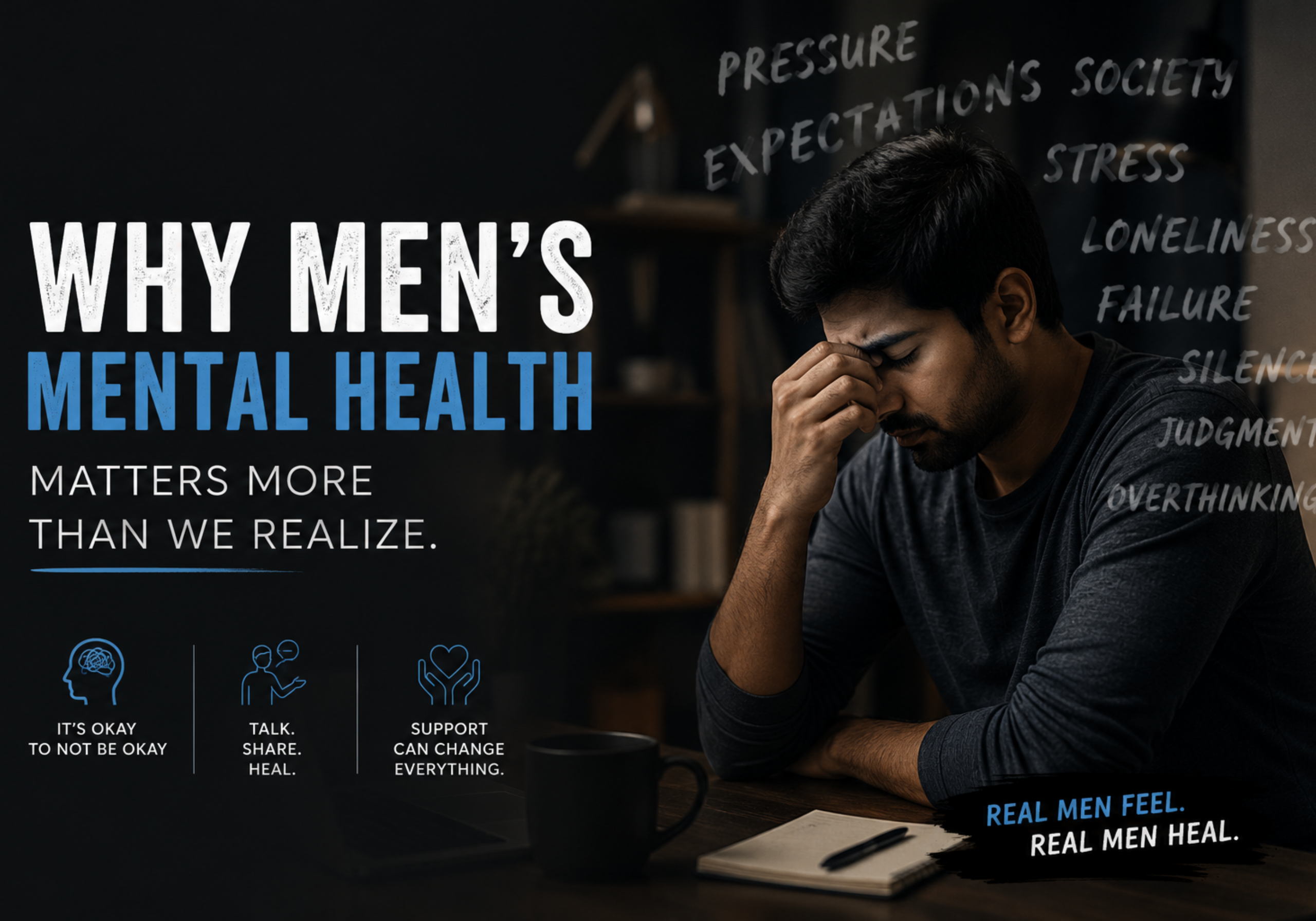
Think about the last time someone asked a man close to you “How are you really doing?” and he actually answered honestly. For many people, that memory is hard to find. Men globally die by suicide at nearly twice the rate of women, according to the World Health Organization. Yet men are consistently less likely to seek help, less likely to name what they are feeling, and more likely to carry emotional weight in silence until it becomes something harder to manage. Why men struggle to open up is a question that touches families, workplaces, relationships and communities. This post looks at what drives that silence, what it costs, what the warning signs look like, and most importantly, what can actually help change it.
Why Men’s Struggle to Open Up About Their Feelings
Cultural Conditioning and “Boys Don’t Cry” Messaging
From a very early age, many boys receive a clear message: emotions are weakness. “Stop crying,” “Man up,” “Be strong,” “Man up.” These phrases are so ordinary that most people say them without thinking. But repeated across childhood, they teach boys that emotional expression is something to suppress, hide, or be ashamed of. Patriarchy plays a significant role here. The system that elevates masculine strength as a social ideal also punishes any deviation from it. Boys learn that being a “real man” means not needing help, not showing fear, and not admitting when something hurts.
How childhood upbringing shapes emotional suppression
When a boy cries and is told to stop, he learns emotions are inconvenient. When he is praised for staying calm in pain, he learns that numbness is strength. These early lessons become habits, and habits become identity. By adulthood, many men genuinely do not know how to access or express what they feel.
Fear of Being Seen as Weak or Vulnerable
Multiple studies show that many men avoid professional mental health services specifically because they fear being perceived as weak. This fear is not unfounded in their experience. Many men have faced mockery, dismissal, or loss of social status when they showed vulnerability. When the social cost of opening up feels higher than the cost of staying silent, silence becomes the rational choice. This is the painful logic behind why men struggle to open up, even when they are genuinely suffering.
Lack of Emotional Vocabulary
Many men struggle to open up simply because they have never been taught the words for what they feel. Anger is familiar. Frustration is familiar. But sadness, grief, loneliness, shame, fear? These emotions often have no clear language for men who were never encouraged to name them. Without a vocabulary for inner experience, it becomes genuinely difficult to communicate it to others, or even to understand it yourself.
Why schools and homes rarely teach boys to name emotions
Emotional literacy is still treated as optional in most educational settings. Boys are taught to read, write, and solve equations. They are rarely taught to identify, name, and express what they feel. That gap follows them into adulthood.

The Hidden Cost of Emotional Suppression
Impact on Mental Health (Anxiety, Depression, Burnout)
When emotions go unexpressed for long periods, they do not disappear. They find other ways out. Research consistently links chronic emotional suppression in men to higher rates of anxiety, depression, and burnout. Men who suppress emotions may experience these as physical tension, chronic irritability or a general sense of emptiness they cannot explain. This emotional suppression was identified as a major barrier to seeking help for mental health issues, and was commonly tied to deeply ingrained masculine identity. Suppressing emotions may offer short-term relief, but over time it increases internal pressure. Burnout in men is particularly underdiagnosed because it often presents as withdrawal or anger rather than the tearfulness and exhaustion more commonly associated with the condition.
Impact on Relationships and Intimacy
Emotional suppression does not stay contained to one area of life. It spreads into relationships. Men who cannot access or express their feelings often struggle with intimacy. They care deeply, yet the tools for emotional closeness were never developed. Partners report feeling shut out, unseen, or emotionally alone in relationships where their partner is physically present but emotionally unavailable. Over time, this creates distance that both people can feel but neither knows how to bridge. Emotional suppression can quietly erode what would otherwise be strong relationships, often long before either person understands what is happening.
Why partners often feel shut out
When one partner consistently deflects or shuts down emotional conversations, the other learns to stop trying. The silence isn’t neutral. It communicates “I won’t let you in,” even if that’s not the intention.
Physical Health Consequences of Bottling Up Emotions
The body keeps score. Research has increasingly linked chronic emotional stress to higher risks of cardiovascular problems, weakened immune function, and elevated cortisol levels. Men who struggle to express emotions are also less likely to seek medical care early, which allows both physical and mental health concerns to worsen before they receive attention.

Signs a Man Might Be Struggling Silently
Behavioral Red Flags (Irritability, Withdrawal, Overworking)
Emotional pain in men often shows up as behavior change rather than direct expression. Irritability that seems disproportionate to the situation is one of the most common signs. So is withdrawal from people and activities that used to bring enjoyment. Overworking is another: filling every hour with tasks is a reliable way to avoid sitting with difficult feelings. Other signs include increased alcohol use, disrupted sleep, dismissiveness in conversations, and physical complaints like headaches or chest tightness with no clear medical cause, why men’s struggle to open up is partly why these signs go unrecognised for so long. The behaviour looks like something other than distress.
What He Might Say Instead of “I’m Struggling”
Men who are struggling emotionally rarely say so directly. Instead, they speak around it.
Common deflection phrases and what they really mean
“I’m just tired.” (I am overwhelmed and do not know how to say it.) “I’m fine.” (I have decided not to open this conversation.) “It’s not a big deal.” (It feels like a very big deal and I am embarrassed by that.) “I just need to keep busy.” (Stillness makes the feelings harder to avoid.) Recognizing these phrases as possible signals rather than simple statements is one of the most useful things people close to men can learn to do.
How to Change That: Practical Steps for Men
Start Small: Naming One Emotion a Day
Emotional openness does not have to begin with a deep conversation. It can begin with a single, private act of naming. At the end of each day, try to identify one emotion you experienced. Skip vague words like “stressed” or “fine” and reach for something more specific: disappointed, anxious, proud, lonely, relieved. The goal is to build the habit of noticing. Emotional vocabulary grows through use, and the practice of naming feelings internally makes it easier to express them when the moment calls for it. This is a small step, but it is a real one. Why men struggle to open up is partly about never having practised the skill.
Finding Safe Spaces to Talk (Friends, Groups, Therapy)
Talking about feelings becomes easier when the environment feels genuinely safe. For some men, this means a trusted friend who has shown they can listen without judgment. For others, it means a men’s group, a peer support community, or an online space where similar experiences are shared. Therapy is another option, and a powerful one, but it requires finding the right fit.

How to find a therapist who works well with men
Look for a therapist who uses practical, goal-oriented approaches alongside emotional exploration. Cognitive Behavioural Therapy (CBT) and Acceptance and Commitment Therapy (ACT) tend to work well with men who are newer to this kind of conversation. Reading a therapist’s profile before booking and asking about their experience with men’s issues in an initial consultation can help ensure a good match.
Reframing Vulnerability as Strength, Not Weakness
The belief that emotional openness is weakness is the central myth that keeps emotional suppression in place. Vulnerability takes courage. Naming what you feel when you have been taught not to is an act of genuine bravery. Research suggests that men who can express emotion tend to have stronger relationships, better physical health, and greater resilience across difficult periods.
Using Physical Activity or Journaling as an Emotional Outlet
For men who find direct verbal expression difficult, alternative outlets can be a starting point. Physical activity, particularly running, swimming, or gym training with a reflective component, can help release emotional tension and create mental space. Journaling is another accessible option. Writing without an audience removes the social risk that often silences men. Even three sentences at the end of the day, about what happened and how it felt, can start to build the emotional self-awareness that makes conversation easier over time.
How Friends, Partners, and Family Can Help
Creating Non-Judgmental Spaces for Conversation
The people around a man play a significant role in whether he feels safe enough to open up. Creating a non-judgmental space means responding to emotional disclosure with curiosity rather than advice, concern rather than alarm, and patience rather than pressure. It means not minimising what he shares (“It could be worse”) and not immediately trying to fix it (“Here’s what you should do”). Simply being present, listening fully, and making clear that the conversation is welcome goes a long way, why men’s struggle to open up is often about never having experienced a space where it felt truly safe to try.
Asking Better Questions Than “Are You Okay?”
“Are you okay?” is easy to deflect. It invites a one-word answer. Better questions open a door rather than requiring someone to push through it.
Being Patient With the Process
Men who have spent years suppressing emotions do not open up overnight. The process is gradual, nonlinear, and sometimes frustrating for everyone involved. If someone shuts down a conversation, it is rarely a permanent refusal. It is often a signal that he is not ready yet, or that the moment. did not feel safe enough. Coming back to the subject gently, without pressure or resentment, keeps the door open.
Breaking the Cycle Starts With One Conversation
Why men’s bottle up their emotions is the predictable result of a culture that has long rewarded silence, punished vulnerability, and defined strength in a way that leaves no room for the full range of human feeling. The cost of that silence is real: in mental health, in relationships, in physical wellbeing, and in the lives of men who reach a breaking point because no one knew they were struggling.
But cycles break. They break in therapy rooms, in late-night conversations between friends, in the moment a father tells his son that it is okay to cry, in the text message that says “I’ve been having a hard time actually.” Each of those moments is small. Together, they shift what feels possible.
Along with understanding why men’s mental health matters, you may also read: – Why Male Actors Hide Their Mental Health Struggles