
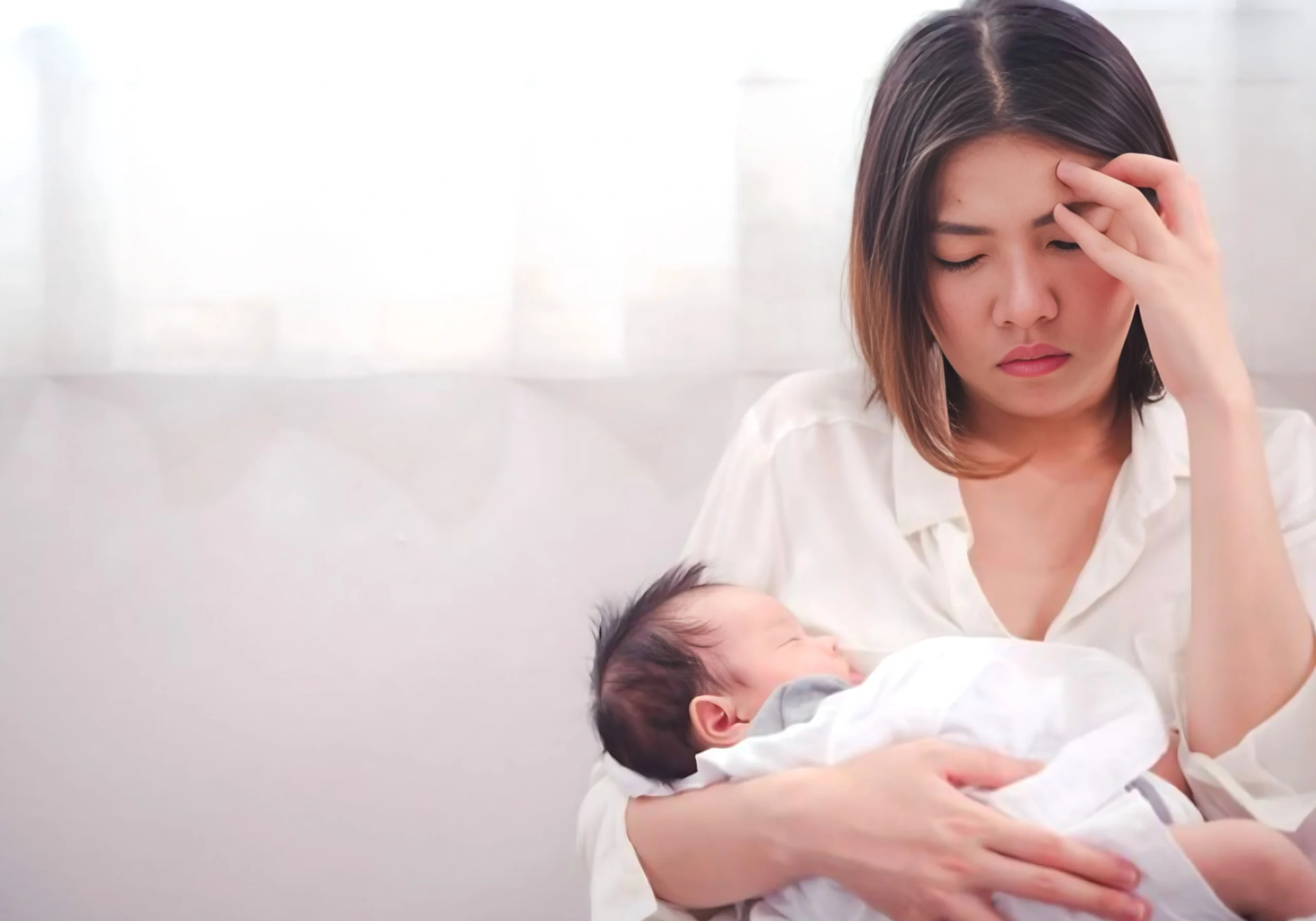
She had a healthy baby. A husband who showed up. She also got a mother-in-law who cooked for the next few months. By every visible measure, everything had gone right. Yet, three weeks after delivery, she was sitting in the bathroom at 2 AM, crying so quietly she couldn’t even hear herself, terrified that someone might walk in and ask her what was wrong. Because what would she say? That she loved her baby and also felt nothing? That she was grateful and also couldn’t stop imagining something terrible happening? That she had never felt more alone in a house full of people?
Nobody had told her this was possible. Nobody had given it a name.
This is the story of postpartum mental health in India, and in far too many homes across the world. It is a story about what happens in the gap between what we celebrate and what we refuse to discuss.
The Gap Between “Baby Blues” and What’s Actually Happening
Most people know two things about mental health after childbirth: that some women get a little emotional in the first few days, and that in extreme cases, a woman can develop postpartum depression. What most people don’t know is that postpartum mental health covers a far wider, messier, and more varied spectrum than either of those categories suggests.
The “baby blues” are real. They affect 50 to 80% of new mothers, typically peak around days three to five after birth, and resolve on their own within two weeks. They are a hormonal adjustment, uncomfortable but temporary.
Postpartum depression is something different, It is persistent, it deepens over time, and it does not resolve without support. In India, the overall prevalence of postpartum depression is around 22%, with some regions reporting rates as high as 48.5%, according to a comprehensive review published in the Journal of Neurosciences in Rural Practice. A meta-analysis covering 2020 to 2024 found that 19% of Indian mothers surveyed had postpartum depression, with rates highest in the southern and western zones of the country. The National Mental Health Survey of India found that 20% of expectant and new mothers in India experience sadness and anxiety.
That is one in five mothers. And those are only the diagnosed and surveyed cases.
But postpartum depression is only one part of the postpartum mental health picture. Postpartum anxiety, postpartum OCD, postpartum rage, postpartum PTSD, and postpartum psychosis all exist on this spectrum. Most of them are barely discussed, even in medical settings. Most of them are almost entirely invisible in Indian social conversation.
The Things Nobody Talks About
Postpartum Anxiety and OCD
When people picture postpartum struggles, they picture a mother who is withdrawn and tearful. They rarely picture a mother who is terrified. Postpartum anxiety affects a significant number of new mothers and can present as relentless, spiraling worry, an inability to sleep even when the baby sleeps, physical symptoms like a racing heart and a tight chest, and a constant, exhausting alertness that doesn’t switch off.
Even less discussed are postpartum OCD and intrusive thoughts, which affect an estimate of 3-7% of new mothers.A mother with postpartum OCD might have recurring, deeply disturbing thoughts about something bad happening to her baby. These thoughts are egodystonic, meaning they are completely contrary to what she wants or values. They horrify her. They do not reflect intent. They are a symptom of a treatable disorder, and they are almost universally kept secret because mothers are terrified that disclosing them will lead to being labeled as unfit parents.
Postpartum Support International is clear on this: intrusive thoughts are entirely different from postpartum psychosis. A mother experiencing intrusive thoughts knows they are wrong and is distressed by them. A mother in psychosis loses touch with reality. The two are not the same, and conflating them causes mothers with OCD to suffer in silence rather than seek the help that would relieve them.
The silence around these postpartum struggles has real consequences. Postpartum anxiety, PTSD, and OCD are underdiagnosed and undertreated precisely because awareness has focused almost entirely on depression.
Postpartum Rage
Even harder to admit is postpartum rage. This is something that barely exists in public conversation, though it exists in private for a significant number of new mothers. The rage is disproportionate, sudden, and frightening. It can be triggered by a crying baby, a partner who sleeps through the 3 AM feed, or something as small as a cup left in the wrong place.
Women experiencing postpartum rage are often terrified to admit it. As one source puts it directly, “Women are terrified to admit they feel rage because society tells them mothers should be infinitely patient and glowing.” The expectation of the serene, selfless mother is so deeply embedded that the presence of rage feels like a personal moral failure rather than a symptom of a genuine mental health condition.
Rage in the postpartum period is frequently a symptom of underlying anxiety, extreme sleep deprivation, sensory overload, or unprocessed trauma from childbirth. It is not a character flaw. It is a signal.
Touch Aversion
Related to postpartum struggles in a way that almost no one discusses openly: touch aversion. A new mother spends her days nursing, carrying, rocking, and being physically contacted by her infant in a way that is essentially constant. By evening, her nervous system is completely saturated. When her partner reaches for her arm, her skin crawls. She snaps “don’t touch me” and then feels guilty about it for hours.
This is not a relationship problem. It is a physiological state of sensory exhaustion. It is also almost never mentioned in any conversation about postpartum mental health, even as it creates tension, guilt, and disconnection in relationships that are already under enormous strain.
Why Postpartum Mental Health in India Is Particularly Difficult to Navigate
India has some particular cultural textures that shape how postpartum struggles are experienced and addressed.
The first is the expectation of gratitude. New mothers are expected to be grateful: for the healthy child, for the family support, for the ability to produce a child at all. Gratitude is a form of social armor, and expressing anything other than it risks being perceived as ungrateful, selfish, or mentally fragile in a way that carries stigma. The woman who received a month of home-cooked meals and family support and still feels hollow is considered incomprehensible. Her postpartum struggles go unnamed and therefore unaddressed.
The second is the relentless focus on the baby. Indian postnatal culture, as wonderful as it can be, is often oriented entirely around the newborn. The mother is tended to in service of the baby’s wellbeing rather than as someone with her own health needs. If she sleeps, it is so she can feed the baby. If she eats, it is so her milk supply remains strong. Her mental experience is incidental.
The third is lack of professional mental health integration in maternal care. In outlying healthcare facilities, mental health professionals are either absent or inaccessible. Many obstetricians and gynecologists are not trained to screen for postpartum mental health conditions beyond the most obvious presentations. Many women who are screened and identified do not receive follow-up care.
The fourth is the son preference dynamic. Research on postpartum mental health in India has identified the birth of a female child as a risk factor for postpartum depression in contexts where family pressure around gender exists.A mother who delivered a daughter into a household that wanted a son is managing her own postpartum mental health while also dealing with the disappointment of her environment. This is a specific and under-discussed dimension of postpartum struggles in the Indian context.
What Good Support Actually Looks Like
Support for postpartum mental health does not look like telling a new mother to count her blessings. It does not look like telling her she will feel better when the baby sleeps through the night. And it does not look like looking at the baby and saying “isn’t this enough to make you happy?”
Real support starts with listening without redirecting. When a mother says she is struggling, the response that actually helps is “tell me more about what you’re going through.” The response that makes things worse is “you have such a beautiful baby, how can you feel this way?”
For family members, the most significant thing they can offer is practical relief without judgment. Taking the baby for a few hours without making the mother feel guilty about stepping back. Managing household logistics so she doesn’t have to. Recognizing that she can love her child and be in genuine distress simultaneously, and that these things are not contradictions.
For partners specifically, understanding that postpartum mental health challenges in the mother are not personal rejections is foundational. The touch aversion, the irritability, the emotional distance, the crying without reason: these are symptoms, not statements about the relationship. The partner who responds with patience and practical involvement, rather than with hurt feelings or pressure, makes a measurable difference.
For healthcare providers, universal screening using validated tools like the Edinburgh Postnatal Depression Scale at multiple postpartum appointments (rather than as a one-time box to tick) is the standard that more facilities need to reach. Mental health referral pathways need to exist and be communicated clearly. And the full range of postpartum mental health conditions, not just depression, needs to be included in provider training.
For the mothers themselves: the shame is not yours to carry. Postpartum struggles are medical events that happen to an enormous number of women. Having them does not make you a bad mother. Hiding them does not make you a strong one. Speaking to a doctor, counselor, a helpline, or a trusted person is not a weakness. It is what the situation requires to handle Postpartum Mental Health.
The Honest Conclusion
Postpartum mental health is one of the most common health events a woman can experience after childbirth, and one of the least openly discussed. The postpartum struggles described in this article are not edge cases. In India alone, 1 in 5 mothers is experiencing postpartum depression. That figure does not include the mothers with postpartum anxiety, postpartum OCD, postpartum rage, or postpartum PTSD. It does not include the mothers who are surviving without being counted.
The woman sitting on the bathroom floor at 2 AM deserves a name for what she is feeling and a pathway to help. She deserves to know that postpartum struggles are real, that they are recognized, that they are treatable, and that she is not the only one. She deserves a society that checks on her with the same attention it gives to checking the baby’s weight.
Postpartum mental health is not a niche concern. It is a basic dimension of maternal wellbeing, and treating it as such is something families, healthcare systems, and communities can choose to do. The resources exist. The knowledge exists. What is needed now is the willingness to have the conversation, openly, without the performance of gratitude or the pressure of perfection.
Along with Postpartum Mental Health, you may also read: – The Price of Being a Woman: What You Need to Know About the Pink Tax