

How social media affects mental health and self-esteem is becoming increasingly evident in today’s digital world. A conversation with a professional from the entertainment industry recently brought a jarring reality to light. He confessed to completely deleting his social media accounts because the platforms had become a direct trigger for depression. Every time he logged on, he was bombarded by images of peers landing new projects, attending wrap parties, and celebrating career milestones. In an industry where your next paycheck is rarely guaranteed, watching a filtered stream of everyone else’s success became too heavy a burden to bear.
His experience exposes a universal truth about the digital spaces we inhabit: social media is not a reflection of reality, but a carefully curated exhibition of our absolute best moments.
The Art of the Selective Highlight
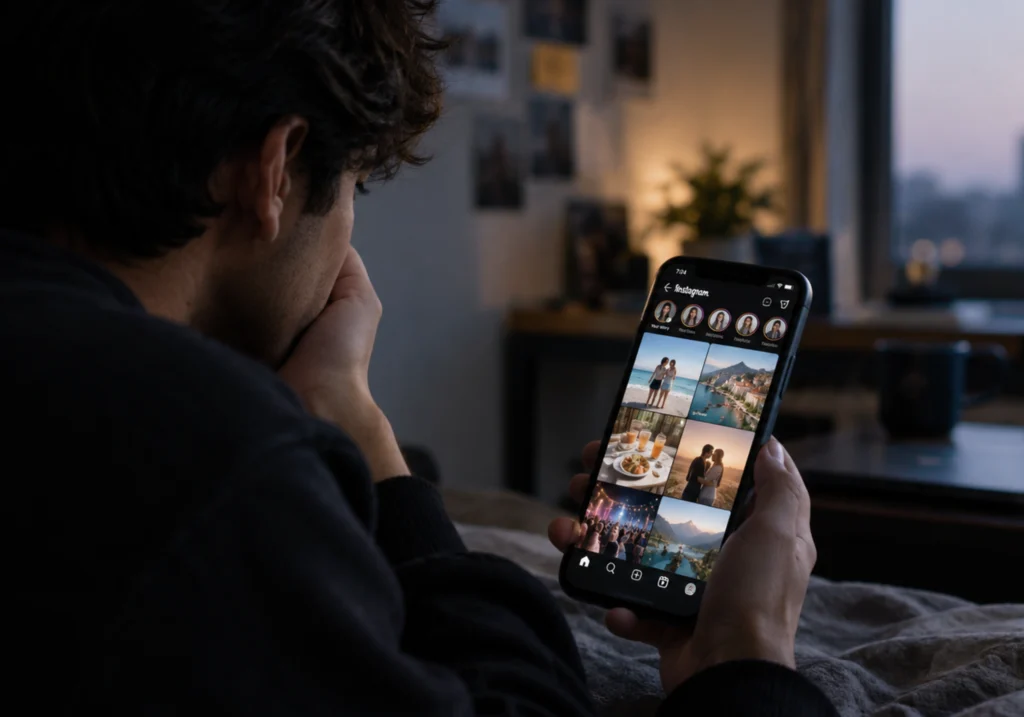
Human beings naturally seek validation, and social media has commodified this urge. We have become the directors of our own mini-documentaries, meticulously choosing which scenes make the final cut. Consider the mundane details of daily life: if someone grabs a quick tea from a local roadside handcart on a rainy Tuesday, it rarely makes it to their Instagram feed. But if that same person is sitting at Starbucks, holding a cup with their name misspelled in an aesthetically pleasing font, it is immediately photographed, filtered, and highlighted.
We broadcast the glamorous and bury the ordinary. When we scroll through our feeds, we aren’t looking at real lives – we are looking at a digital museum of idealised lifestyles, beautiful locations, and perpetual fun.
Behind the Perfect Facade
This curated perfection extends far beyond careers and coffee; it deeply distorts our perception of human relationships. Our feeds are flooded with lavish anniversary tributes, ecstatic birthday wishes, and photos of seemingly flawless couples. Yet, the emotional depth of a relationship cannot be measured by a grid post.
In fact, the disparity between digital projection and real-world friction is often staggering. It is not uncommon to see couples who are privately heading toward a separation publicly wishing each other a “Happy Birthday” or a “Blessed Anniversary” on Facebook, complete with heart emojis and declarations of eternal love. The digital post becomes a shield, a way to maintain appearances or convince themselves—and the world—that everything is fine.
When outsiders take these posts at face value, the psychological toll is severe. Someone sitting at home, struggling to find work or dealing with loneliness, looks at these “perfect” marriages and “ideal” lives and wonders, Why am I the only one failing?
Do We Really Need to Take Social Media Seriously?
The short answer is no. Taking social media seriously is akin to walking into a movie theatre, watching a heavily edited blockbuster, and leaving depressed that your own life doesn’t feature a cinematic soundtrack or a flawless script.
Social media is a utility – a tool for communication, entertainment, and networking. The moment we begin using it as a yardstick to measure our self-worth, our relationships, or our career progress, we enter a losing battle. We are comparing our chaotic, unedited “behind-the-scenes” footage with everyone else’s polished, colour-graded trailer. Stepping back, setting strict digital boundaries, or even following the lead of that entertainment insider by deleting the apps entirely isn’t a sign of weakness. It is an act of self-preservation. True contentment is found when we put down the screen, stop looking at the filtered lives of others, and start investing in the unfiltered beauty of our own.